


Paths for the Dead: From the Egyptian Book of the Dead to the Mexican Day of the Dead

Updated: Jan 27
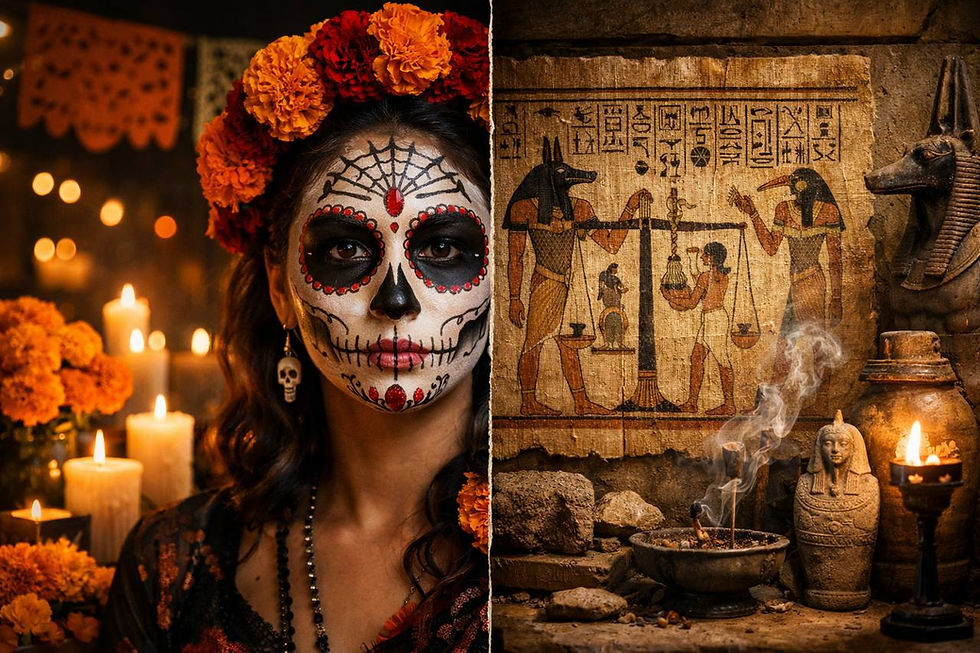
In a lecture by Aba al-Sadiq, he spoke about the Egyptian traditions of death and the afterlife. As a Mexican, I realised that Mexico is one of the countries that is still constantly aware of death and even celebrates it.
Could it be possible to speak to the dead? This is a fascinating question that many of us have asked. Even at school in my country, they used to tell us, “On these days, the dead come home.” We would buy gifts for our relatives who had passed away as a way to honour them.
For some, the idea of communicating with the dead may sound far-fetched. Yet for millions in Mexico, it is a deeply rooted belief — one that comes to life each year during the “Día de los Muertos” or Day of the Dead. As time passes, some of us wonder if it is a pagan or sacred celebration. We find ourselves somewhere between belief and doubt.

This long-standing tradition is widely held across the country and continues to draw curious visitors from around the world. More than a festive occasion, it is a cultural event that honours loved ones who have passed away. It is also a constant reminder of our spiritual connection with those no longer with us. But is this merely a pagan custom, or could it point to a religious obligation found in other faiths as well?
In this article, we explore these questions — through the lens of history, religion and the insightful teachings of Aba al-Sadiq. The origin of the celebration goes back more than 3,000 years, to the Indigenous peoples of Mesoamerica, including the Aztecs, Toltecs, Olmecs, Maya and other Nahua cultures. They viewed death as a natural continuation of life rather than an end. The Aztecs, for example, worshipped the goddess Mictecacihuatl, the Lady of the Dead, and believed in a cyclical vision of life and death.

Originally, the feast of the dead was held in August, but later, when the Spanish arrived, a strong syncretism with Catholic tradition began. The practices merged with the Catholic feasts introduced by the Spanish colonisers, aligning the celebration with All Saints’ Day (1 November) and All Souls’ Day (2 November) and giving rise to the modern two-day observance. The colonisers tried to change the culture and sometimes even killed Indigenous people who continued venerating their gods, attempting to erase their traditions.
For these ancient peoples, death was a constitutive part of life. They even drew a parallel with the beating of the heart, with its systole and diastole: contraction and expansion, life and death, as two movements of the same living reality.

Where the Dead Still Walk: The True Origins of Día de Muertos
To understand the traditions of the Day of the Dead, we have to remember that this feast is rooted in pre-Hispanic beliefs – it is truly death before the Conquest.
The Mexica (Aztecs) believed that the world had been created and destroyed several times. They spoke of Five Suns, five great ages. We live under the Fifth Sun. The world is cyclical: each sun ends and must be renewed, and every new age demands sacrifice and humility.

According to the legend of the Fifth Sun, at the end of the Fourth Sun the gods gathered at Teotihuacan to decide who would sacrifice himself so that a new world could begin. The old fire god Huehuetéotl lit a great sacrificial bonfire, but none of the most important gods wanted to jump into the flames. The rich and proud god Tecuciztécatl, the Lord of the Snails, hesitated. During that hesitation, the humble and sick Nanahuatzin – whose name means “full of sores” – threw himself into the fire and became the new Sun.
Tecuciztécatl then jumped in after him and became a second sun. However, the gods realised that two suns would burn and overwhelm the world, so they threw a rabbit at Tecuciztécatl to weaken his light. He became the Moon. That, they say, is why many people still see the shape of a rabbit on the face of the moon today.
The idea that even the gods have to die so that the world can live is a fascinating one. Mortality, death and regeneration are at the centre of this cosmovision: death is not an end, but a transformation, a seed for new life – of the sun, of human beings, of the cosmic cycle itself.
In this worldview, the dead did not all go to the same place. Their destiny depended above all on how they died. Those who died of old age or ordinary illness began a long journey to Mictlan, the land of the dead, passing through different trials until they reached a final state of rest. Children who died in innocence went to Chichihuacuauhco, a place where a great tree dripped milk from its branches to feed them until the time of a new creation. Warriors who died in battle, and people sacrificed to the gods, went to accompany the sun on its daily journey across the sky, shouting and singing so that it would not stop. Women who died in childbirth were honoured in the same way as fallen warriors, because childbirth was also seen as a form of battle; they became powerful spirits known as Cihuateteo, “divine women”, linked to the path of the sun.
The Mexica ritual calendar also included great feasts of the dead. There was a “small feast” dedicated especially to deceased children and a “great feast” for adults. These celebrations lasted many days and were filled with offerings, flowers, food and rituals for those who had gone before.
Centuries later, these ancient celebrations were overlaid with Christian feasts. In Rome, a special day was established to honour all the martyrs and saints, at first celebrated on 13 May. Later, the date was moved to 1 November, close to the Celtic festival of Samhain, which marked the end of the harvest and the beginning of the dark half of the year, also associated with the dead. Over time, the evening before became known as All Hallows’ Eve – Halloween.
When Spanish friars arrived in Mesoamerica, they brought with them these Christian celebrations of All Saints’ Day and All Souls’ Day. Faced with the powerful Indigenous cult of the dead, they did not erase it completely but compressed and merged it with the Christian calendar. Out of that encounter came the modern Día de Muertos: a feast now concentrated into two days, but still carrying within it the deep memory of Mictlan, of the children of Chichihuacuauhco, of the warriors of the sun and of the women who died giving life.
Those Who Die for God: A Shared Promise
This idea – that those who die for the highest cause are not truly lost – appears in many other traditions as well. In the Qur’an, God speaks directly about those who are killed in His path:
“Do not say of those who are killed in the way of God that they are dead. Rather, they are alive, but you do not perceive it.” (Holy Quran 2:154)
And again:
“Do not think of those who are killed in the way of God as dead. Rather, they are alive with their Lord, receiving provision.”
Here, physical death is not seen as the final word, but as a passage into a more intense life in the presence of God. In the Bible, the same intuition appears. Jesus says:
“Blessed are those who are persecuted because of righteousness, for theirs is the kingdom of heaven.” (Matthew 5:10)
In another vision, the book of Revelation shows the souls of those who were killed for the word of God crying out under the heavenly altar, and they are told to rest until their number is complete. Their blood is not forgotten; it is remembered and honoured in heaven. Jewish tradition, too, preserves stories of men and women who preferred death to betraying the covenant, trusting that “the King of the world will raise us up to live again forever.”
Across these scriptures, the pattern repeats: those who give their lives for God, for justice or for the covenant are not swallowed by nothingness; they are received, remembered and rewarded. This resonates strongly with the Mexica belief that warriors and women who die in childbirth go to accompany the sun, and later with the Christian memory of martyrs whose bones and relics were carefully gathered and venerated. In all these worlds, death for the Highest becomes a door, not a curtain.
Ka, Ba and Cempasúchil: Mirrors Between Egypt and Mexico
The custom of commemorating the dead is very strong in Mexico. When we place it side by side with Egypt, as Aba al-Sadiq does in his lecture, the parallels become striking. The Egyptians spent enormous resources building tombs and equipping them for the afterlife. The Mexicans build altars full of colour and life. Both are, in their own way, technologies of communication with those who have passed on.
To see the bridges between Egypt and Mexico, we can look carefully at the Mexican ofrenda or “offering”. The altar of the dead is like a little universe built in the living room or on a grave: a staircase between our world and the world of the spirits. The most complete version is the altar of seven levels, although many families use only two or three, depending on space and local custom. Two levels usually speak of heaven and earth; three of heaven, earth and the underworld or purgatory; and seven are the full journey of the soul, step by step, towards rest.
In his lecture, Aba al-Sadiq reminds us that the Egyptian rites for the dead are not naïve superstition, but an advanced form of communication between the living and those who have passed on. If we look at the Mexican altar with that in mind, we can see the same thing: a relationship made of symbols.
First level – The saint
At the top, people place the image of a saint or the Virgin, the spiritual protector of the family. This presence watches over the souls and guides them on their way back home. In Egyptian tombs something similar happens: the highest “place” around the dead is filled with images of the gods – Osiris, Anubis, Hathor – who welcome and protect the soul. In both cases the message is the same: you are not walking alone.
Second level – Souls in purgatory
The next level is often dedicated to the souls in purgatory. Candles and small images are placed for them, asking these souls to help the deceased receive permission to visit the world of the living. It is a level of solidarity: even among the dead there is mutual help. The Egyptians also believed that the dead, if they were properly cared for with offerings and prayers, could support and intercede for their family from the other side. The bond continues in both directions.
Third level – Salt and purification
Here we find salt, a symbol of protection and spiritual cleanliness, especially for the souls of children. Salt keeps corruption away on the road there and back. In Egypt, salt and natron were used to dry and purify the body during mummification. The goal was not only to preserve the flesh but to prepare the person for judgment with a light, pure heart. Different rituals, same concern.
Fourth level – Pan de muerto and the bones
On the fourth step, people place the Pan de Muerto, the bread of the dead. Its round form and the “bones” drawn on top speak of the cycle of life and death, and for Christians it also echoes the Eucharist and the body of Christ. It is as if the family says: “Your bones are not forgotten; you are still part of our daily bread.” The Egyptians expressed this with the whole science of mummification: preserving bones and body so that the ba could recognise them and the dead could rise again as a luminous akh.
Fifth level – Food and water: feeding the soul
This step is the most delicious. Here we put the favourite food and drink of the person – mole, tamales, fruit, coffee, tequila – and always water for the long road. The smell of the dishes is an invitation: “Come, this is your place.” In Egypt, the ka – the life-double of the person – also depended on bread, beer, meat and the perfume of incense left on the offering table.
The ofrenda and the Egyptian table are doing the same work: sending energy to the soul. At the same time, the preparation of the food nourishes the hearts of those who are still alive and processing their grief.
Sixth level – Portrait and memory
On the sixth level we place the photo of the deceased or objects that belonged to them. The altar becomes completely personal: this is for my mother, my brother, my child. In Egyptian tombs, the equivalent is the false door and the serdab, the hidden niche with statues or carved images of the dead. The spirit could “come out” through that door to receive offerings and then return. For both cultures, image and name are sacred: they are small houses where the presence of the dead can rest.
Seventh level – Cross and flowers: the threshold
At floor level, the altar is closed with a cross of marigold petals, seeds and fruits. The bright orange of the cempasúchil marks the point where the altar touches the earth and shows the entrance to the path. It is a Christian sign built with Indigenous flowers – a visible symbol of the fusion between the two worlds. In Egypt, the threshold is marked by the stone false door and the offering table that stand at ground level in the chapel. That is where the living come to speak and where the dead “cross” into our world. Flowers or stone, both mark the door.
Around these levels, many other signs appear. Sugar skulls remind us that death is always present and that every name will one day be written there. Calaverita poems play with the idea of our own death, like gentle rehearsals, just as Egyptian spells rehearsed the words that must be spoken in the afterlife. Candles are lit so the souls do not walk in the dark. Copal and incense clean the space and open an invisible road with their scent, very close to the Egyptian idea of perfumes as the “breath of the gods”. Marigold paths guide the dead from the street or the cemetery to the altar, echoing the paths, doors and gates drawn on Egyptian papyri.
All of this clearly helps the dead in the imagination of both cultures – but it also helps the living. Building an altar, arranging a grave, lighting a candle on a park bench or at a war pilot’s tomb: these are ways of continuing a conversation. They tell us that love is stronger than distance, that death is not total silence, and that we too are on the same road, step by step.
From Ofrenda to Park Bench: Everyday Altars for the Dead
We have to remember that human beings carry a deep need to keep speaking with those who have gone. This need appears in many shapes, from the Mexican ofrenda full of colours and candles to something as simple as a bench in a quiet park in England.

In many towns of the United Kingdom there is a memorial bench or dedication scheme. A family can ask the council to place a new bench or add a small plaque to an existing one. The council chooses the style and the exact place, so the benches fit into the park. But once the plaque is fixed, that ordinary bench becomes something more. Every time someone sits there and reads the inscription, the name and the story of that person are remembered. Some benches even have photos hanging from the arms, or small plants and ribbons tied to them. They are reminders of happy moments shared with someone who is no longer physically here – or maybe they are still here in some way, as long as someone remembers them.
I personally like to go to cemeteries and read the inscriptions on the stones. In the town of Nantwich, there is one grave that fits perfectly with the theme of this article. The stone says:
ARTHUR L. BROWN
U.S.A.A.F.
AGED 23 YEARS
OF NEW YORK
WHO CRASHED
IN HIS THUNDERBOLT
TO AVOID THIS TOWN
JAN. 14TH 1944
WITH SYMPATHY AND RESPECT
On 14 January 1944 his aircraft got into trouble over Cheshire. Witnesses saw it performing strange movements in the sky before going into a fatal dive near Nantwich. Local memory says that he stayed with the aircraft and guided it away from the houses so that it crashed in open ground instead of on the town. His body and his plane still lie there, beneath that stone. People decorate the grave with flowers and poppy wreaths, and each year there is a small ceremony. It is another kind of altar: a simple slab of stone, but charged with gratitude for someone who died so that others could live.

If we put all this together with what we have seen before – the Egyptian offerings of incense and food to the ka and ba, the Mexican altars full of marigolds, bread, sugar skulls and photographs, the prayers for martyrs and saints in Islam and Christianity – a pattern becomes clear. All around the world, people build everyday altars for the dead. Sometimes they are huge public ofrendas in the Zócalo of Mexico City, sometimes candle-lit boats on the lake of Pátzcuaro, sometimes just a wooden bench with a little plaque in a green English park.

In Mexico, devotion explodes into colour, taste, smell and sound: flowers and candles, copal smoke and music, pan de muerto and calaverita poems. In Egypt, the language is stone, perfume and carved spells. In Britain, it may be a quiet bench or a war grave under the rain. But in all these places, the intention is the same: to keep the relationship open, to say to our dead, you are still part of us. Because as we learned in the lecture from Aba Al-Sadiq, the dead count on our remembrance. We should remember the dead, this was even advised to us from the Ahlul Bayt.
Imam Ali ibn Abi Talib said:
“Visit your dead, for they rejoice at your visit.” One of the companions of Abu ‘Abd Allah asked: “A man stands at the grave of his father, his relative, and one who is not his relative–does that benefit the deceased?’ He said: ‘Yes, it reaches him just as a gift reaches any one of you.’”
The lecture of Aba al-Sadiq, which inspired these reflections, offers a wider key to understand this. He shows that many ancient customs we are quick to label as “pagan” are in fact sacred technologies of communication between two interconnected worlds. They give us hope that death is not pure silence, but a passage; not the destruction of the bond, but its transformation. Our altars – whether ofrendas, tombs, benches or incense tables – are the visible doors of that invisible conversation. The Dead do need and receive our prayers, visitations and gifts–and one day when our death approaches, we will hope for the same.
Watch the Lecture that Inspired this Article:


Comments