


A Statue that Acts Alive: A Real Story from Mexico

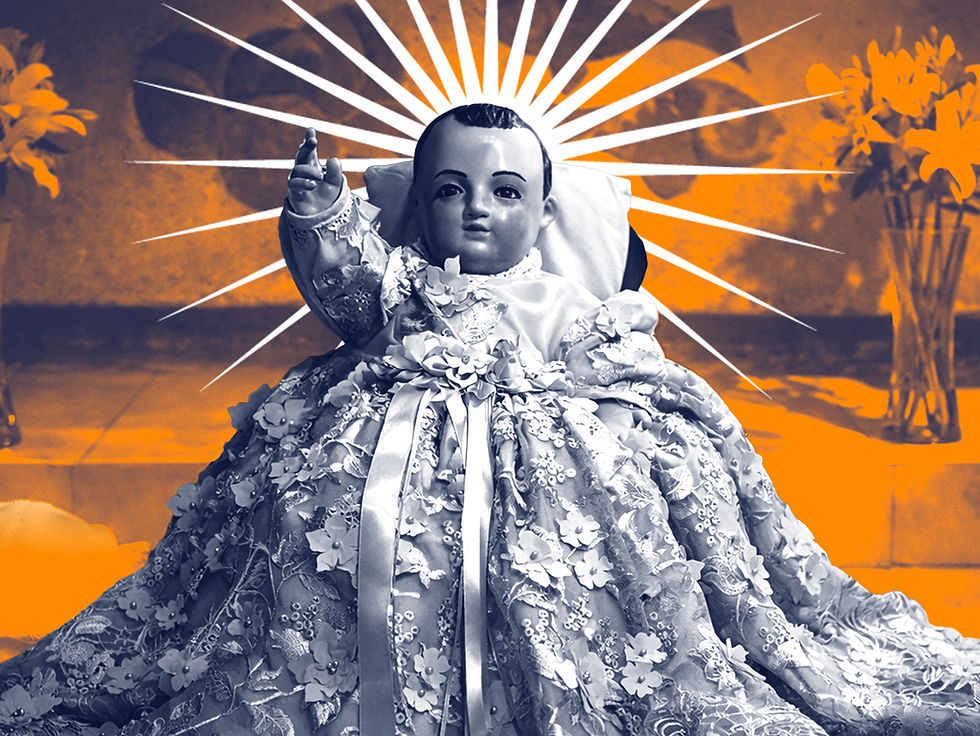
In Xochimilco, Mexico City, the Niñopa is the community’s centrepiece of faith and identity. Each year on the 2nd of February (Candlemas), a new caretaker family (mayordomía) hosts the image for the year. Tradition holds that the image was carved in the sixteenth century by an Indigenous artisan from palo de colorín wood.
Many locals have long associated the Child symbolically with Huitzilopochtli—“the hummingbird of the south”—an example of religious syncretism that took shape in Mexico during evangelisation by Spanish missionaries.
Pairing familiar sacred motifs with Christian images often reduced resistance among communities living under colonial pressure. Across Mexico, there are visible layers of this history: in Cholula, for example, the Sanctuary of Our Lady of Remedies stands atop the Great Pyramid once dedicated to Quetzalcóatl, patron of the priesthood and a god of wisdom, learning, and intelligence.

There is reportedly a waiting list for stewardship that extends into the 2040s, with some families waiting decades. The mayordomía is a cherished local custom: the family that hosts the image takes responsibility for the annual programme of prayer, visits, and hospitality.
The handover and major processions are accompanied by groups of chinelos, who parade through the streets in tall feathered hats, embroidered capes, and masks with pale faces and stylised beards. Crowds accompany the Niñopa from the outgoing steward’s home to San Bernardino de Siena for Mass, many carrying their own images of the Christ Child under various titles (advocaciones—that is, devotional or patronal titles linked to places or communities).
Locals treat the Niñopa as a living child. Under the mayordomía, the family dresses him, lulls him and rocks him to sleep each night, and symbolically “feeds” him—gestures of love that require significant resources to host guests and organise meals in his honour. They offer him toys to “play” with—balls, balloons, and other traditional gifts. In some years these toys are later donated to local children; in other years they are kept as part of the Niñopa’s patrimony, depending on the mayordomía. His belongings are extensive: when the image moves between stewards, three to four lorries, each carrying three to four tonnes, may be needed to transport clothes, toys, and household gifts.

Devotees report small signs—soft steps, moved toys, a warming presence. Some say that, by morning, his clothes bear earth or grass as if he had visited the garden; others whisper that he tastes the food left for him or that they have heard gentle laughter at night. A few witnesses say his cheeks change colour when he visits the sick, as a sign of hope or warning. Many also say he “enjoys” rides on the flower-decked trajineras, the canal boats of Xochimilco. For believers, these reports connect with wider traditions of “living” images across cultures.
The daily rhythm is carefully organised. On weekdays, the Niñopa is taken on scheduled home and institutional visits—sometimes on foot with the chinelos, sometimes by car. Mass may be celebrated at the nearest church or, on occasion, at the host home. Some visits are public, others private; most are offered in thanksgiving for perceived favours or healings. At 8:00 p.m. every day, the community gathers for the rosary led by the current steward. On Sundays there are no home visits; instead, the steward takes the Niñopa to San Bernardino for the 5:30 p.m. Mass, after which the image returns in procession for the rosary. Every year on the 2nd of February (Candlemas), a new family receives the image amid music and dance, and they provide large pots of food—tamales, rice, mole, and more—to feed the crowds.

Oral testimony: the story of Guillermo
Guillermo had hoped to host the Niñopa since childhood. At around twenty, he suffered a violent assault that left him with a fractured jaw and an intestinal perforation, requiring a long recovery during which his mother, Pilar, says faith kept him alive. He later studied paediatrics, and—after many years on the waiting list—finally received the stewardship in 2003. According to those close to the mayordomía, preparations took roughly two years.
On the eve of Candlemas, he coordinated the floral decorations and served at the altar. During the handover Mass, after the obligations were read, Guillermo made the traditional promise: “Mi casa desde hoy es la casa del pueblo”—“From today, my home is the people’s home.”
From the church, a large crowd accompanied the image to the López Caleano home, where an abundant public meal was served and teams were organised for music, prayer, and daily logistics. The family had reportedly waited decades for their turn to serve as stewards, preparing far in advance with street decorations, banners, tables, and volunteers.
I once worked with a nurse who hosted the Niñopa; she told me many miracles had happened in her life. Although the family spent significant money and effort—because they hosted and fed everyone who came to venerate the image—she gratefully remembers the privilege of hosting the Child.
There are also countless testimonies from people who say they received favours through an image. As a child, my father visited The Lord of the Wonders (El Señor de las Maravillas), and my mother made a yearly pilgrimage to Our Lady of Guadalupe (La Virgen de Guadalupe), the image with the largest following in Mexico. Around 11–12 million pilgrims typically visit the Basilica of Guadalupe between the 8th and 12th of December, with even more across the whole month. Some approach on their knees—sometimes to the point of bleeding—others walk for hours or even several days from across the country, some carrying heavy images or running barefoot along Mexico’s roads.
From childhood rituals to cautious Faith
Even now, I think of images as mirrors of the invisible. They were part of my Catholic childhood; I kept some at home and followed many small rituals in daily life. Later, reading Scripture, I took seriously the warnings against idols:
“Do not make any idols.” (Exodus 34:17)
“You shall not make for yourself an image… You shall not bow down to them or worship them.” (Deuteronomy 5:8–9)
For a long time, I avoided all images of saints and sacred figures, believing that honouring them might risk dishonouring God. Many Sunni Muslims, for different theological reasons, also emphasise aniconism (caution regarding sacred images). I understand the desire not to do anything against God—yet people keep speaking about miracles: statues that “laugh,” “eat,” or offer help.
Are people lying? Are such signs demonic? We simply want to worship God rightly—but can we ignore that witnesses exist? That is why this lecture fascinated me: it offers a framework to consider what might be hidden in plain sight—as the writer Edgar Allan Poe illustrated in “The Purloined Letter.” And, of course, modern films often play with the idea of possessed objects or haunted images, which keeps the question alive in popular culture.
Do Images Hold Power? Devotees, Doubters, and Santería Rites
We had rarely imagined statues could act like living beings. Still, devotees tell stories that deserve a fair investigation. What fascinated me in Aba al-Sadiq’s lecture was the reminder that, in some Christian contexts, images are veiled or even defaced—eyes and noses removed—to make clear that they hold no power of their own. If images are powerless, why such caution? The point, as the lecture argues, is to prevent misdirected devotion, not to grant power to the object. It is more a matter of recognizing that it is not the image itself, but rather whom it represents that, in certain cases, becomes something like a means of receiving the intersection of holy people. Although it is not true that all of them have power, some do, which you can see in more detail in the lecture by Aba al-Sadiq.
(Full Lecture posted at bottom of this article)
I remember priests of Santería telling me that if someone can no longer keep the obligations, a consecrated object should not be thrown away. Instead, one should consult a babalawo or santero to perform an ebbó—a ritual “decommissioning” that releases the consecration. One priest warned that discarding a sacred object without the proper rite could bring serious harm—even death.
Gathered with What We Worship
Only after Aba al-Sadiq’s explanation did the matter make sense. The testimony of witnesses—those who venerate different images in Mexico or consecrate objects in Santería—supports this line of thought. Such rituals, whether “feeding” images or consecrating and later “releasing” objects, are widespread and culturally accepted. This is where the Prophet Muhammad’s warning, and the Qur’anic teaching, take force: that people are gathered with those they followed—and with whatever they worshipped.
“[The angels will be told:] Gather the wrongdoers with their counterparts, and whatever they used to worship.” (Qur’an 37:22)
Again, the devil took him to a very high mountain… “All this I will give you,” he said, “if you will bow down and worship me.” Jesus said to him, “Away from me, Satan! For it is written: ‘Worship the Lord your God, and serve Him only.’” (Matthew 4:9–10, NIV)
A warning in the story of the calf
"In the absence of Moses, his people made from their jewellery a calf—an image that lowed. Did they not see that it could neither speak to them nor guide them to the right path? Yet they took it as a god and became wrongdoers." (Qur’an 7:148)
Many overlook that the text says the calf made a sound—it “lowed.” In another lecture, Aba al-Sadiq suggests the maker “drew on Gabriel’s power.” Whether one accepts that reading, or sees the sound as a trick or a misperception, the effect was the same: the community was drawn into misplaced devotion. It is another example of an image tied to a sense of real—even supernatural—force.
We know how the story ends. We are often amazed by wonders, but we rarely consider the consequences.
“And if Allah had willed, He could have made you one nation; but He sends astray whom He wills and guides whom He wills. And you will surely be questioned about what you used to do.” (Qur’an 16:93)
Although it is not true that all of them have power, some do, which you can see in more detail in the lecture by Aba al-Sadiq. Then we can better understand the difference between worship that is mediated by God and worship that is not.
From Healing Sign to Broken Idol: Nehushtan’s Lesson
In the lecture He gave us the example of the snake, that some Christians relate it to the cross.

The Lord said to Moses, “Make a snake and put it up on a pole; anyone who is bitten can look at it and live.” So Moses made a bronze snake and put it up on a pole. Then when anyone was bitten by a snake and looked at the bronze snake, they lived. This happens after the Israelites complained in the wilderness and were bitten by “fiery serpents”. (Numbers 21:8–9)
Name & meaning:
Later the bronze serpent is called Nehushtan.
“He removed the high places, smashed the sacred stones and cut down the Asherah poles. He broke into pieces the bronze snake Moses had made, for up to that time the Israelites had been burning incense to it. (It was called Nehushtan.)” (2 Kings 18:4)
Most scholars read this as a dismissive nickname meaning “a piece of bronze” (from neḥoshet = bronze), playing on naḥash = serpent.
Why a serpent? In the ancient Near East, serpents often symbolised healing and protection (compare the later Greco-Roman staff of Asclepius). The point, however, was never the object’s power, but God’s mercy.
The lesson. Over time, people can misplace devotion—directing it to an object rather than to God. That is why Hezekiah later broke the serpent: a reminder that signs may help for a moment, but they must not become our focus. We have to distinguish between using a symbol and worshipping a symbol, and avoid treating it as a substitute for God.
Sign, Spirit, and Prudence
As Aba al-Sadiq explained (drawing on the Perfect Sermon, Asclepius XXIV), some traditions hold that certain images can “receive spirit,” appear in dreams, give warnings, and—by God’s permission—bring comfort or lift sorrow when fitting. Scripture holds a real tension: on the one hand, God commands images as signs (e.g., the cherubim over the Ark, Exodus 25:18–22); on the other, He forbids worshipping them or any part of creation.
It is wise to describe any “agency” with care. In some Christian settings, custodians have treated objects as empowered or “active” until a rite of release/deconsecration is performed; practices vary from veiling or defacing faces (to prevent misdirected devotion) to stricter removal. By contrast, some Shi‘a contexts allow broader devotional use within bounds. The common point is intention: the sign must point to God without replacing Him.
It is also true that, in appearance, certain circles can seem to venerate the statuette more than God. This calls for prudence because the Bible and the Qur’an forbid worship of created things. The classic distinction helps: to venerate a sign that points to God is not to worship it; but when attention fixes on the object, the sign becomes a stumbling block.
Other reports from around the world
It isn’t only in one place that such signs are reported.
Delhi, 1995 — the “Milk Miracle”. Thousands said that a spoonful of milk held to a Ganesha idol “disappeared,” as if the idol drank. Investigators proposed capillary action and surface tension; devotees focused on prayer, generosity, and remembrance of God.
Manchester, 2013 — the rotating Neb-Senu statuette.In the first-floor Egyptian galleries at Manchester Museum, a small Middle Kingdom statuette (Neb-Senu, c. 1800 BCE) appeared to turn by itself in its case (caught on time-lapse) appeared to turn by itself inside a sealed, wall-mounted display case. Staff captured the motion on time-lapse video and noted that the case was locked and positioned within the gallery rather than near an entrance, making drafts unlikely. Long-time staff also remarked that in all the years the object had been on similar surfaces, no one had ever seen it move before—2013 was the first recorded instance.
In ancient Egypt, such figures could function as backup vessels if the mummy was damaged—highlighting how objects were once imagined to “stand in” for a person.
Egypt — luminous apparitions and myrrh icons. From 1968–71 in Zeitoun (Cairo) and again in 2000–01 in Assiut, very large mixed crowds reported luminous figures over Coptic churches. Contemporary accounts describe tens of thousands on peak nights and, over the months, hundreds of thousands of witnesses in total. Observers included Coptic Orthodox and other Christians, Muslims, and people of no stated faith. Separately, some churches have reported icons exuding oil/myrrh. Whether read as grace or as misunderstood natural effects, these accounts prompted prayer, repentance, and charity.
Pop-culture and ritual “feeding”. The Annabelle/Raggedy Ann doll popularised claims of objects that move or harm; and in Afro-Atlantic traditions with Yoruba roots, consecrated fundamentos/otanes are treated as living and ritually fed. Not every report is supernatural; many have natural explanations. Taken together, however, they show why people still speak of “living images.”
Why revisit these accounts now?
Since Aba Al-Sadiq has been speaking about this possibility as real, revisiting these accounts makes sense. Natural explanations often exist, and we should examine them more carefully. We must resist confirmation bias—seeking only what supports our view—and we must not ignore Scripture cited in the lecture. The safe centre is clear: if a sign does anything, it is only by God’s permission; the sign must lead us back to Him.
“If Allah had willed, He could have made you one nation; but He sends astray whom He wills and guides whom He wills. And you will surely be questioned about what you used to do.” (Qur’an 16:93)
From Staffs and Serpents to Right Worship
"So Moses and Aaron went to Pharaoh and did just as the Lord commanded. Aaron threw his staff down in front of Pharaoh and his officials, and it became a snake. Pharaoh then summoned wise men and sorcerers, and the Egyptian magicians also did the same things by their secret arts: each one threw down his staff and it became a snake. But Aaron’s staff swallowed up their staffs." (Exodus 7:10–12)
Rabbinic commentaries deepen the point. Shemot Rabbah 3:12 recounts the first sign given to Moses (Exodus 4), when the staff became a serpent and Moses recoiled in fear. Shemot Rabbah 8:3 says the staff bore the Divine Name and was passed down from the patriarchs—its “power” derived from God, not from wood or magic. Some midrashim even link the staff to creation, underscoring that the sign’s authority is borrowed, not inherent.
The Qur’an echoes this logic of permission:
“I fashion for you out of clay the form of a bird; I breathe into it and it becomes a bird—by Allah’s permission.” (Qur’an 3:49)
Such passages do not invite us to argue abstractly about the “power” of objects; they teach discernment: what matters is who authorises, what it points to and where it leads.
Conclusion — Sign over Spectacle
Object-focused piety sits close to what many would call magic. The message is the same in Scripture: when a sign becomes the center, it must be broken, like Nehushtan. When a sign points beyond itself, it serves.
We can spend our wealth, faith and strength on creation, or we can embrace the Creator, who alone grants power to His creation. The Niñopa shows how love translates into lullabies, meals, rosaries, and Masses; prudence asks where our final devotion rests. Scripture is plain:
“No one can serve two masters. Either you will hate the one and love the other." (Matthew 6:24)
From the Ahmadi Religion of peace and Light's perspective, God’s guidance is living—the Mahdi foretold by earlier prophets, from Jesus to Muhammad (peace be upon him and his family). The wisest investment of our time and resources is in the Living Guidance God sends, not in objects.
Venerating statues for favours can tether our hearts to the visible world; worshipping God turns signs into pathways, not pitfalls. God discloses hidden things through His messengers; this re-orients us from chasing marvels to walking in His enduring covenant with humanity. To love the Lord with all our heart, mind, and soul is to seek not merely daily comforts but true illumination—and to give our admiration and gratitude where they are due.


Comments