


How Aba Al-Sadiq Saved Me From Euthanasia

Content note: This story references chronic illness and suicidal thoughts.
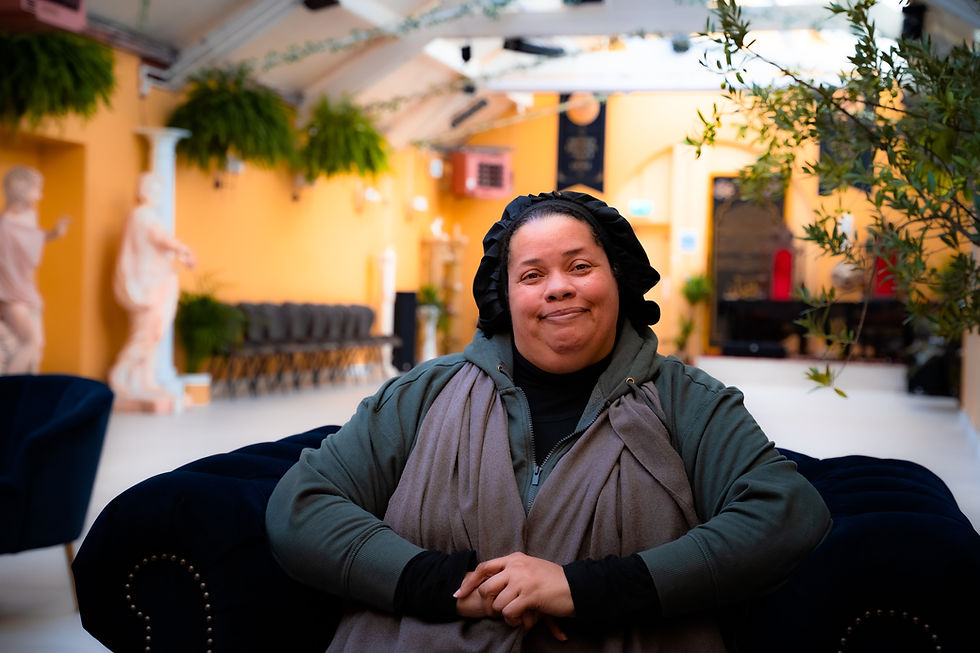
This article is about Isabel. She is a living testament to the fact that the belief in Aba Al-Sadiq can turn around lives - and even save them. She was recommended by her doctors to end her life due to her chronic illness and contemplated taking their advice. Until Aba Al-Sadiq opened his arms to invite her to live with him in his community.
A Hard Beginning
Isabel was born in Puerto Rico and grew up without a stable family. She explains: “I was abandoned by my own family, especially by my mother, at the hospital. Growing up alone, abandoned by family, hated by them, by my father and mother and sisters and brothers, was very hard and painful.”
As a teenager and young adult she encountered homelessness in Pennsylvania while working and studying: “I didn’t know what a home was… I slept on the sidewalk. I worked and studied. I became pregnant while living in the streets. I lived under a bridge, in cold and fear; it was very horrible.”
Even then, Isabel leaned toward service. She trained as a midwife’s assistant and pursued social work studies to help youth avoid the streets: “I wanted to study to help young people so they wouldn’t go through what I went through.”
Years later, Isabel spent nearly a decade assisting births in the Amazon: “I saw something magical: a woman giving birth to twins without pain or shouting… the births were so fast we had to hold the babies quickly. We were surprised. That experience taught me that women are stronger than they think. We bring life into the world even with sacrifice.”
“I Thought my Time was Over”
Years of poverty and stress severely damaged Isabel’s health. In the U.S. doctors told her recovery was unlikely. “A doctor told me I probably had six months to a year,” she recalls. A psychologist then raised the option of euthanasia: “He told me that I could consider assisted death, and that ‘God forgives’ because I was suffering a lot.”
She attended a group session: “They explained the methods — pills, injection, a gas-bed. I thought, ‘What am I doing here?’ But the pain was stronger than the confusion.”
Before taking the next critical step, she contacted the Outreach team of the Ahmadi Religion of Peace and Light, “I had to call my Spanish Outreach contacts Kevin, Verónica, Ismael… and Dr. Yasmine. They told me that the Father doesn’t want his daughter to do that.”
Soon after, she received an unexpected invitation: “Father (Aba Al-Sadiq) asked me to come visit him. I said I would stay seven days, but in my heart it was forever, I felt this was my home.”
Care, Discipline — and a Turning Point

On her arrival, she received love and care from the community. Hundreds of open arms hugged her when she entered through the basilica doors. Suddenly Isabella was not alone anymore. She had hundreds of sisters, brothers, mothers and daughters that were concerned about her and her health.
And it was not only love that she received but also health care support. An experienced physician placed her on a strict program: “At first I thought that diet was intense — only salad and a protein, once a day. I wondered if I could resist. Now it’s been about 14–15 days and it’s working.”
Changes came quickly: “People told me my face looks brighter, they see me happier and with more energy.”
She describes a private moment with the Mahdi that strengthened her hope: “He came with a glass of cold water. When I drank it, I felt a current inside my body… and then all the pain left — my liver, my legs. It was very beautiful.”
Today she says simply: “I feel like a baby; I feel like I was born again.”
On Medicine — and what Patients Need
Isabel is candid about her experience with the U.S. system: “Doctors may have the best equipment, but they don’t listen. They prescribe quickly. Many patients don’t need more drugs; they need love and understanding… and natural treatments.”
Her plea to clinicians is straightforward: “Listen to your patients. Don’t rush decisions. Try not to give poison to the sick. What many need is love, patience, and remedies from nature.”
“To those considering assisted suicide because they’ve been told there is no hope, she says: “Don’t do it. The solution is to seek God… The only one who gives life is the one who can take it.”
Community life has been part of her healing: “Everything has changed — from the inside out. I feel more protected and nourished… community members even choose to eat my diet meal with me to help me, without me asking.”
Isabel now wants to serve: “My mission is to carry the message… to work, to help our brothers, and help protect Father.”
We’re genuinely surprised by how quickly some improvements have appeared in Isabel’s mood, clarity, and energy. We also know there is a long road ahead—medical follow-up, consistency, and daily discipline. For us, Isabel is exactly the person our community should protect: vulnerable yet resilient, wounded yet ready to serve.
Her story also clarifies what we owe one another. A Divine Just State is not a slogan—it’s a system where every believer is both cared for and responsible to care. Some of us are naturally inclined to nurture, heal, teach, cook, drive, clean, build, or organize; those brothers and sisters should be trusted with those tasks. All of us must be willing to lift one another’s burdens—quietly, steadily, day after day—until care becomes the culture.
We are encouraged by Isabel’s early steps, and we’re sober about the work ahead. If our community means anything, it must mean this: no one is left behind, and everyone who can care, cares. That is how a just state begins—one shared meal, one clinic visit, one patient conversation at a time. And this is how it is in the community built by Aba Al-Sadiq.


I am glad to hear of a happy ending to such a story.
Sister I am so happy for you. Im happy that you finally found your Soul family that loves you so much.
This world without Love is Nothing !
This was truly a beautiful heart warming read. Thank you 🙏🏼❤️